Tuesday, February 4, 2020

Little Drummer Boy

This past Sunday, we were privileged to be at the Bloomington Catholic Worker in Bloomington, Indiana. Matt prepared a wonderful worship service for us to share which included several of the lectionary readings for the week. He read them each twice slowly with silence in between the readings. I invite you to read them in the same way:
 
Micah 6:6-8
6 “With what shall I come before the Lord,
and bow myself before God on high?
Shall I come before him with burnt offerings,
with calves a year old?
7 Will the Lord be pleased with thousands of rams,
with ten thousands of rivers of oil?
Shall I give my firstborn for my transgression,
the fruit of my body for the sin of my soul?”
8 He has told you, O man, what is good;
and what does the Lord require of you
but to do justice, and to love kindness,
and to walk humbly with your God?
 
1 Corinthians 1:26-31
26 For consider your calling, brothers: not many of you were wise according to worldly standards, not many were powerful, not many were of noble birth. 27 But God chose what is foolish in the world to shame the wise; God chose what is weak in the world to shame the strong; 28 God chose what is low and despised in the world, even things that are not, to bring to nothing things that are, 29 so that no human being might boast in the presence of God. 30 And because of him you are in Christ Jesus, who became to us wisdom from God, righteousness and sanctification and redemption, 31 so that, as it is written, “Let the one who boasts, boast in the Lord.” 
 

Matthew 5:1-12
Seeing the crowds, he went up on the mountain, and when he sat down, his disciples came to him.
2 And he opened his mouth and taught them, saying:
3 “Blessed are the poor in spirit, for theirs is the kingdom of heaven.
4 “Blessed are those who mourn, for they shall be comforted.
5 “Blessed are the meek, for they shall inherit the earth.
6 “Blessed are those who hunger and thirst for righteousness, for they shall be satisfied.
7 “Blessed are the merciful, for they shall receive mercy.
8 “Blessed are the pure in heart, for they shall see God.
9 “Blessed are the peacemakers, for they shall be called sons of God.
10 “Blessed are those who are persecuted for righteousness' sake, for theirs is the kingdom of heaven. 
 
As I sat in silence, the image and the song of the Little Drummer Boy came vividly to mind. I have always loved this song and I can't ever sing through it without crying. I was reminded of the TV special that was on when I was a kid. It was TERRIFYING! It begins with the "little drummer boy" playing with his animal friends in the desert. The narrator tells us several times through the 30-minute special that he hates people, all people. Within minutes, the boy is kidnapped by two men who want to use him and his performing animals to make money. We are told in a flashback that his farm was burned down and he escaped while his parents perished - which is the reason he hates people. 
 I think it was the wording in Micah that made the connection for me. The asking how to come before the Lord and what to bring made me think of that one with "no gift to bring that's fit to give our king." 
Then as we moved on to the 1 Corinthians passage, I already had this picture and so it was reinforced with the weak, low and despised being chosen. Also, the "not many were powerful, not many were of noble birth" phrase resonated with this little drummer boy image - especially the one in the TV special. 
As I listened to the Beatitudes, those beautiful familiar blessings, they also had new meaning in the context of this simple children's song. I hadn't seen the TV special in years, but I had a vague memory of the boy being poor, orphaned and kidnapped. He was poor in spirit and mourning and meek and hungering for things to be made right. 
Since I hadn't seen it in decades, I decided to watch it when I got home. It was definitely just as scary as I remembered it and also didn't really stand the test of time in respect to how some of the Middle Eastern characters are portrayed, but there were a few pleasant surprises. The transformation of the main character who learns to give up his hate in the presence of his Savior for one. But the most surprising was the last sentence in the show as the music swells and the "camera" pulls back from the manger scene to the star overhead: "Blessed are the pure in heart, for they shall see God."

Tuesday, January 28, 2020

Lapis Lazuli

This week as I was reading through Exodus, a passage jumped out at me. I have been reading the Bible for as long as I have known how to read and I have always enjoyed the Pentateuch. Some find it tedious or unnecessarily detailed, but I have always found it interesting. All of the descriptions of the laws and the garments. The instructions for building, for partying, for creating a life together between God and God's people.
But this week as I read Exodus 24, when I got to verses 9 - 11, I felt like I had never read those verses before! I'm sure I have, but I don't remember them. When this happens, it always feels like a portal has opened up, a secret passageway that I could have sworn wasn't there before.
Here the verses are in the New Living Translation:
"Then Moses, Aaron, Nadab, Abihu, and the seventy elders of Israel climbed up the mountain. There they saw the God of Israel. Under his feet there seemed to be a surface of brilliant blue lapis lazuli, as clear as the sky itself. And though these nobles of Israel gazed upon God, he did not destroy them. In fact, they ate a covenant meal, eating and drinking in his presence!"
I love this picture of a party to celebrate the peace/covenant made between God and God's people. There is so little description and I want to know so much more!
What did they eat? Did God serve them food? Why do they only mention God's feet? Did the surface separate them or were they all on it together? 
When I was little, my family went to see the King Tut exhibit at the Field Museum here in Chicago. It was 1977 and I remember waiting and waiting to get into the exhibit. I'm not sure what 7 year old me thought was behind those doors, but the waiting heightened my expectations. 
It was late by the time we went into the exhibit and the hush and the darkness were palpable. There were glass cases containing treasures, each one lit from inside - the majority of the light in the room came from these magical boxes. Traveling back in time to ancient Egypt, touching a bit of history. Mummies and pharaohs were mysterious figures, one from cartoons and the other from bible stories. I don't remember much of what I saw that night, but I do remember seeing lapis lazuli for the first time. The blue was so stunning and I loved the sounds of the words together. So luxurious. So kingly. 
This passage's mention of lapis lazuli transported me back to that night for a moment, and some of the emotions from that experience seem apropos - the awe and wonder in the presence of a king, the timelessness, the inability to describe what I saw. 
Whatever Moses and his family and the elders saw that day, I am sure it was full of these same emotions. Sometimes the telling of it doesn't measure up, so it seems better to treasure it instead. 
Lately I find myself doing this. Instead of taking pictures of gatherings with friends, I find that the times I don't post on social media or document it in any way are more precious to me. A time to treasure and not to broadcast. A private moment. A hidden event. Just a sentence in my journal or a ticket stub. 
Whatever happened that day on the mountain was just such a moment. A time to bolster these leaders as they prepared for their wilderness journey. A reminder that God was with them and would feed and provide. A seal on the covenant that they were making together. 
Throughout the wilderness wanderings and the making and keeping of the tabernacle, the color blue will be a major theme. Blue threads, blue cloths to cover the most holy instruments of worship.
The surface was also described as "clear as the sky" - did they look up on a clear day and reminisce about that time at God's table? Built into creation and commandments, there are these reminders of God's presence and provision.
This story is an example of God breaking through in a tangible way. The blue surface seems to be the most vibrant memory from that day. In my life, the times that I have felt closest to God sometimes have these types of touchstones: a smell, a touch, a sound, a feeling. Then when I see that color or touch that ticket stub in my pocket, or whatever it is, I am reminded of God's faithfulness. And just for a moment, I am transported to my hidden life with God and I feast on God's presence. 

Monday, January 20, 2020

Good News for All People


This week in our scripture readings, the people of Israel made it into Egypt. It is a story of redemption and reconnection. A resurrection story - this son that Jacob thought was dead is alive, the son that was lost is found. The family moves to the land of Goshen and settles separately from the Egyptians because of their agrarian way of life.

Fast forward hundreds of years and the Israelites have become numerous and the new rulers in the land fear them and enslave them. God’s desire is to fulfill God’s promise to the people of Israel that they would live in the land of Canaan - the land promised to Abraham.

God calls to Moses from the burning bush to get his attention. The beginning of many strange wonders, but Moses has a hard time trusting God. In order to show Moses that God desires a collaboration, God gives Moses a partner - his brother Aaron - to accompany him. Through a series of devastating plagues, God demonstrates sovereignty over the gods of Egypt and provision for the people of Israel. Before each one, God gives Pharaoh a chance to avoid the oncoming plague.

This has always been presented to me as a story of good guys and bad guys. God’s chosen people and those destined for destruction. It’s easier that way. Clear winners and losers. But I am trying to listen better to the good news for all, so I tried to see how this story could possibly be good news for Pharaoh and the Egyptians. 

In the specific context of Egypt, they worshiped many gods - even Pharaoh was considered a god in human form - often as Horus, the son of Ra. Each of the plagues dismantled the power of the Egyptian gods in increasing measure of importance and power. The last two plagues, darkness and death of the first born, attack Ra, the Sun god, and Pharaoh as the son of Ra.

That’s part of the good news for the oppressors.. A chance to see that the gods that they depend on for their safety and dominance are nothing compared to the God of the universe. God dismantles the systems little by little, giving Pharaoh a chance to change - to repent.

The redemption for the enslaved people was physical freedom, but the redemption for the oppressors was breaking down the systems that made enslavement possible. Israel will be on the receiving end of this type of redemption several hundreds of years later when they find themselves conquered and in exile. It can’t be good news for Judah and Israel later if it is not also good news for Pharaoh and Egypt now.

As I was praying about how this story could possibly be good for all parties in the story, the picture of the end scene of The Lord of the Flies flashed into my mind.

If you haven’t read it or seen any of the film adaptations, the basic story is of a group of boys who find themselves without adult supervision on a deserted island after their plane is shot down and the pilot (the only adult!) is killed in the crash. They start to develop some rules of order and leadership, but things start to disintegrate quickly as one of the boys, Jack, sets himself against Ralph. He leads most of the others to accidentally kill a boy named Simon during a frenzied violent “dance” and mistreat and eventually kill another boy whom they nicknamed Piggy.

At the end of the book, Jack is leading all of the other boys to hunt down and kill Ralph. They can’t find him in the thick jungle of the island and so they decide to smoke him out. This large fire attracts the attention of a nearby ship who comes to the island to see what is happening.

As Ralph emerges from the cover of the jungle onto the beach where he is vulnerable and exposed to his attackers, he finds himself at the feet of a soldier. As the other boys emerge from the jungle, screaming and covered with war paint and wielding homemade weapons, they too see the soldier and they are stopped in their tracks.

In the 90s film version, the soldier says to the boys, “What are you guys doing?” In the book, it is even more profound and deeply layered: “What have you been doing? Having a war or something?” This interruption provides salvation for not just Ralph but also for the boys who were about to do something unthinkable and destructive. This type of violent behavior affects the perpetrators as trauma.

In this article on the Inclusion Solution’s website, this type of trauma is described:
  • Mark Charles, a Native American (Navajo) pastor and activist, contends that white people who have perpetrated injustices against people of color over generations also experience trauma, not as victims but as perpetrators. Perpetration Induced Traumatic Stress (PITS), a term coined by peace psychologist Rachel MacNair, describes incidents of PTSD resulting from the trauma of having committed violence, as contrasted with trauma caused by witnessing or being the recipient of a violent act. Charles says that a nation built on 500 years of perpetuating injustices must also be experiencing historical trauma. He quotes Socrates: “The doer of injustice is more miserable than the sufferer. “ 
This act of the Egyptians giving up their wealth to the formerly enslaved people, this example of reparations, is part of their redemption story. The good news for the oppressors (and we’ll see this later when Nehemiah goes back to rebuild) is that they can participate in the restoration of the oppressed. 

This concept is part of the messianic song which we see in Isaiah and then again in Luke:
Every valley shall be raised up,
every mountain and hill made low;
the rough ground shall become level,
the rugged places a plain.
And the glory of the Lord will be revealed,
and all people will see it together.
For the mouth of the Lord has spoken.
The good news for the oppressors is different from the good news for the oppressed. For those of us experiencing relative privilege in the world, the words of John the Baptist provide a simple path to this type of redemption: “Anyone who has two shirts should share with the one who has none, and anyone who has food should do the same.”

And of course, Jesus Himself gives us instructions along these same lines when He describes the sheep and goats: “I was hungry and you gave me something to eat, I was thirsty and you gave me something to drink, I was a stranger and you invited me in, I needed clothes and you clothed me, I was sick and you looked after me, I was in prison and you came to visit me,” (more on this here).

At Uptown Church yesterday, Pastor Jeremy gave a similar message. In our sermon series on the Lord’s Prayer, the focus was on the first words, “Our Father.” This inclusive, plural pronoun packs a punch. It shows that God is the God of all! In the practice of faith in this country, this has not been the case. He reminded us of the words of the Rev. Dr. Martin Luther King Jr., “the most segregated hour of Christian America is 11 o'clock on Sunday morning.” He then outlined racial injustices in the history of the church, in particular around the Great Awakening and the Asuza Street Revival.

I am thankful to be part of a church that is actively seeking to give voice to the disenfranchised and marginalized among us in Uptown. Our corporate benediction reflects our values: “Lord, help us to disrupt suffering and mend what is broken with the hope of Jesus.”

As I read the Old Testament this winter, I am asking God for the grace to read from the perspective of an oppressor. I am asking God to show me the good news for all people so that I, together with every nation, tribe, language and people, can look into the face of my Savior and be made whole in His presence.


Monday, January 13, 2020

Look at Things in New Ways

Many years ago, I was driving in rural Illinois when all of the sudden the car filled with a familiar but unpleasant odor. "Ugh, a skunk!" I lamented. My friend, who had grown up on a farm, commented, "I actually kinda like it. It's just a strong musky smell." I was shocked. I had never heard anyone say anything positive about skunk smell! After she said this, I breathed in a little of the odor with this in mind, and it really didn't smell as bad as I thought. In fact, as it dissipated, I started to see what she meant. 
This moment has become a memorial to me of sorts. I have often thought back to this when I hear or read things radically different than what I have heard most of my life - especially when I realize I am just parroting some idea or thought that is widely held but rarely challenged. 
Recently, I have been thinking a lot about what I learned about women in the Bible and women's roles in church and home. Most of what I heard and thought was what might be considered traditional or conservative. Women supporting men in roles of leadership but not leading themselves. No women pastors or elders.  
I am thankful to have landed in a denomination that recognizes women in leadership and I am now a pastor myself, but that didn't keep the old thoughts and rationales from rising up again as I started to read through the Bible at the beginning of the month. There are still so many places in the church where women leaders aren't affirmed. The recent comments from John MacArthur about Beth Moore and the subsequent responses doubling down in his defense started making me feel discouraged. So many voices saying that they are seeing things "biblically" and that the issue was "clear."
As I started the bible reading plan, I asked God to show me as I read through the Old Testament what God thinks about women. Not that I hadn't thought of this before, but I really wanted to hear God for Godself on the issue and not any other voices. 
The first story in the bible where anyone has any dialogue has a woman main character. Have you ever thought of that? I don't know about you, but all during my school years, most books we read had male protagonists. If a movie or a book has a female lead, it's usually considered a "chick flick" or "empowering" and the expected audience is female. But here we see a strong female character. She has agency, leadership, influence - she makes a decision to be independent of God and to have the ability to decide good and evil for herself. This is usually considered to be the fall of humanity, but in many senses, it is actually the rise of humanity - this act sets in motion the complicated and intricate plan of redemption and salvation of a people with the freedom to choose.
Several chapters later, the main character of one of the stories is Hagar, a slave woman who has been mistreated and runs away from her masters. In this story, a disenfranchised woman is sought out by God - God appears to her, talks to her, addresses her plight and redirects her path. She gives God a name - "the God who sees." God talks to her again after she is sent away a second time.
Sarah is also a main character in this story with a lot of agency (for good and bad) who is also addressed by God through angelic messengers.  
Rebekah is also a strong female character - God talks to her directly concerning her unborn children. In the story of her family, we know about her preferential treatment of her younger son and the role she plays in the trickery that he undertakes to steal the blessing from his brother. 
Already in the story that God is telling about God's people, there are enough indications that who the women are and what they do is significant to God. Women are named, have agency, are talked to directly. In most history books that I read in school, I do not remember hearing any stories of women. If there were an occasional story about a woman, she was usually someone's wife or mother (which is also sometimes the case in the biblical narratives) but definitely not disenfranchised or powerless. 
I am definitely hearing God loud and clear that women are valued and their voices matter. 
Going back to the skunk story, maybe you think it's a stinky example (ha!) since it's so widely acknowledged as being a "bad" smell. I think that is precisely why it is such a great analogy. According to Rachel S. Herz, Ph.D, odor preference is learned and not hardwired. I think that some of the ways that people arrive at their beliefs are influenced by their environment and/or "inherited." I find it refreshing to read and reread God's word with the Holy Spirit guiding my thoughts and pointing out things I hadn't seen before. As Jesus said to His disciples, "every teacher of the law who has become a disciple in the kingdom of heaven is like the owner of a house who brings out of his storeroom new treasures as well as old.” I am looking forward to polishing some old treasures that I cherish and also to discovering new ones in the vast storeroom of God's word.

Sunday, January 5, 2020

So Many Threads


Inspired by the weekly liturgical writings of Debi Thomas, I made a New Year's resolution of sorts to write each week reflecting on the readings in the Read Scripture app that we are doing together as Uptown Church. I love the Bible Project and was so excited to hear that we are doing this together. Reading the Bible as a people has always been God's intent - one of the many threads we see throughout the Word, but I am getting ahead of myself. 

At the end of last year, my friend Angela posted a picture of her loom and a piece of cloth that she had woven. I have vague memories of my mom having a loom when I was very young and I definitely remember passing the shuttle back and forth and pressing the threads together. I didn't realize that this image was in the back of my mind while I was reading this week until I got to the story of Melchizedek. This verse stood out to me: "Then Melchizedek king of Salem brought out bread and wine. He was priest of God Most High" Genesis 14:18. When I saw the bread and wine reference, I wrote down in my journal, "so many threads to follow." Immediately, the picture of Angela's loom was in my mind and her comment of having to rethread the 300+ threads several times to get it right. 

Is the world God's great loom? or is time the great framework? This made me stop and think of all the threads that are already started in the first 18 chapters of Genesis: 
  • covenant
  • belief/trust in God
  • good and evil
  • barren women/birth/seed
  • trees
  • offering/altars/sacrifice
  • stories with women main characters
I am excited to watch these threads be woven again and again into the story of God and God's people partnering together to make a world where God is welcome and the people of God are a blessing to those around them. 

I watched a lot of weaving videos and they were all so beautiful and breathtaking. The attention to detail. The breadth of the set up and preparation. Mostly replaced by machines these days, but still so many made by hand - all over the world! The one machine that especially caught my attention was the Jacquard loom - probably because of my love of mathematics and order but also because of the nature of the process.  Watch here for a short explanation.


I am hoping to write a poem each week as well, but I am not going to force it. This is one that I wrote in the wee hours of the morning today as I prayed and reflected on the many threads we are invited to follow.

The Master Weaver
a reflection on Genesis 1 - 18  

In the beginning
the framework was bare
the Master Weaver assembled the loom
tying countless strings
blocking the pattern
preparing the cards
then, when all was in it's proper place,
the machinery lurched into action
strings going every which way
the slap of the beater
the motion of the treadles 
the shuttle passes through
back and forth
each pass creating a new measure of fabric
threads combining
being forced together
this seemingly chaotic concomitance of chords
making order out of the tangled webs
the weft. the warp.
passing through the proper threads
at the proper time
this intelligent design
counterweights from above
working in concert with the countless threads
to make a single cloth
the fabric lengthens
until the time when
the pattern is complete
the final card is read
the final row is secured
the fabric is ready to be cut loose
all the loose ends tied
the rough edges made plain
ready to be placed
on the banquet table

Thursday, March 21, 2019

When The Party’s Over


For the last few weeks, a line from a song has been on repeat in my head. And though sometimes there are just ear worms that invade my brain because a song is catchy, this felt different. The song itself has a haunting melody and the line that keeps playing is “when the party’s over, will you take me home?” The music and the words are full of such longing and sadness and speak to the part of my soul that is world-weary and discouraged. I see a girl standing in the midst of the wreckage of a wild party. There is garbage and dirty dishes and vomit and destruction all around her. In the midst of the party, I sense her making eye contact with her friend, her lover, her parent - someone who she senses will be there at the end. Someone who she senses will get her out of the mess and take her away from there. 

I like this metaphor of a party because I love to throw parties. I have often set up parties from start to finish. Moving every chair into place. Decorating each table’s center. Setting each fork and knife and spoon just so. Making sure everyone has what they need. Filling water glasses, answering questions, serving food. And then at the end of the night, restoring the room to the clean slate. Everything back in its proper place. I am always exhausted and ready to go home.

I was recently behind the scenes at a gala for a non-profit. Auction items were going for over $10,000 a piece. Everyone sitting at their beautiful tables talking and laughing with one another hardly noticed how many people it took to make the evening seem so flawless. But I noticed. When it was time for dinner, 3-4 servers descended on each of the 41 tables with precision so that everyone at the table got their food at the same time. And similarly, as people finished, their plates were whisked away. Out of sight, out of mind.

Jesus talked a lot about parties. He also attended parties. Many gospel stories happen at a dinner or a party. Jesus talks about throwing parties over lost sheep, coins and sons. He talks about inviting people off the street, about how not to take the best seat, about accepting an invitation to a party without making excuses. He eats dinner with all sorts of people, many of them shocking or surprising to the religious people of his day.

I have been participating in an Ignatian Bible Study for the past year and a half in which we do a lot of imaginative prayer. One way to engage in this practice is to put yourself in the story - imagine yourself as one of the people in the scene - and write a first-person present account of what is happening. It’s interesting where I see myself in these scenes. Sometimes I do imagine that I am a servant in the home where the dinner is happening. I’m overhearing the conversation as an outsider. In those imaginings, Jesus’ words are especially comforting. Hopeful. Restorative. But if I put myself in the place of the Pharisees, I find Jesus’ words combative, threatening and challenging. “Who does He think He is?”


Recently at Uptown Church, there was a Bible Study for doubters. Anyone who felt like they had questions or doubts was invited to be a part of this group. My friend Linda, who lives in our neighborhood, decided to join. Linda has had a rough life and as a single, older African-American woman she had a particular perspective to share. One Sunday, as two younger white guys were discussing their doubts and questions about the thief on the cross and his promise of paradise, Linda interrupted. “There had better be something after this life! This can’t be all there is.”

Romans 8:18 - 23 says it this way, “Yet what we suffer now is nothing compared to the glory he will reveal to us later. For all creation is waiting eagerly for that future day when God will reveal his children. Against its will, all creation was subjected to God’s curse. But with eager hope, the creation looks forward to the day when it will join God’s children in glorious freedom from death and decay. For we know that all creation has been groaning as in the pains of childbirth right up to the present time. And we believers also groan, even though we have the Holy Spirit within us as a foretaste of future glory, for we long for our bodies to be released from sin and suffering.”

As believing people, we are called to groan alongside those who groan - recognizing the signs of decay and being a part of the restoration of God’s kingdom here and now. Maybe the sheep and the goats parable is more about position than anything else. You saw someone hungry or naked or sick and you knew it was your job to feed or clothe or visit them. Not your job, but a sign that you are part of the movement of God to make things right in the world. The need, the lack, the sickness is a direct and outward sign that things are not ok. That our world needs saving. That God’s ways are not in place.

Luke reiterates the words of Isaiah as he tells of John’s mission: “Prepare the way of the Lord, make his paths straight. Every valley shall be filled, and every mountain and hill shall be made low, and the crooked shall be made straight, and the rough ways made smooth” In this gospel account, it goes on to describe John instructing people to share if they have coats or food to spare and not to extort or cheat their fellow humans.

As people of God, we are foreigners and strangers in this world. We are looking forward to our new home, as the writer of Hebrews says, we are “longing for a better country—a heavenly one.” While the great human party is divided between the haves and the have-nots, the heavenly party awaits where all are welcome and all are equal. As we participate in making this human party more equal, we declare that God’s kingdom is arriving. We prepare the way. Every place that Christians come to should be affected in this way. Relationships restored. Inequities evened out. Barriers broken down.

But for every barrier knocked down, the enemy puts up a new one. For every relationship restored, others are broken apart. The work is constant and the signs of destruction are rampant. We will not see the promises fulfilled - only at a distance, in a dim glass.

After putting on a big party or wedding, after the last dish is washed and dried and put away, I want nothing more than to soak in a bath or lay in my bed. It reminds me of C.S. Lewis’s description of heaven: “the bathrooms are all ready, the towels put out, and the clean clothes in the airing cupboard.” So I will not grow weary, for He who calls me is faithful. And in a little while, He who is coming will come and will not delay.

When the party’s over, God will take me home.


listen to the song here: https://www.youtube.com/watch?v=GXYtwL4DXRU

Sunday, September 2, 2018

The Meaning of Sacrifice


This past winter, I was reading a book for pleasure entitled “The Ministry of Utmost Happiness” by Arundhati Roy. It was a strange but beautiful novel; as one reviewer described it “attentive to the dispossessed, the marginalised, and the oppressed; fractured, broken, and sprawling.” I was enjoying it and it was, as all good stories do, speaking to me on a heart level, but I wasn’t prepared for the way it stopped me in my tracks. The main character in the book was a poor Muslim woman and unable to afford an animal to sacrifice on Eid. A friend gives her a goat and she treats the goat as a member of the family. She lets it sleep in the house and takes special care of it. She explains her care for the goat with this sentence that made me put the book down: “Love, after all, is the ingredient that separates a sacrifice from ordinary, everyday butchery.”

Since then, I have been thinking a lot about the word sacrifice and the act of sacrifice. I have been asking people what they think the word means in a modern and a biblical sense and I have been reading over scriptures in both old and new testaments that talk about sacrifice.

It’s a word we see all the time and it is used to describe heroic acts or giving up something good for something better. There is usually some sense of bargaining or leverage inherent in the word. At its best it sounds noble, but at its worst it sounds manipulative. He sacrificed his life for his country. Your father and I have sacrificed a lot for you to be able to go to university.

The English word comes from Latin sacra meaning sacred, dedicated, holy + combining form of facere "to make, to do". So it could be translated as make holy or perform a sacred act. The Hebrew word for “sacrifice” is korban קרבן which means “coming closer”. Looking at the roots of this word and digging into the verses about sacrifice gave me a richer picture of this word. I don’t do this for purely academic reasons. I want to understand what God is trying to say to me. As I was doing this, I realized that pouring over scripture with the intent to draw near to God is a sacrifice of time worth giving.


During this process, I was reminded of a film I saw a couple years ago called Arrival. If you haven’t seen it, I highly recommend it. In the film, Dr. Louise Banks, a linguist played by Amy Adams, is hired by the government to decipher a message from aliens. Their written language is a nonlinear orthography - which means that there is no beginning or end in the structure of a written thought - which is why the phrases are written in a circle.

As the movie progresses, Dr. Banks and her team learn more and more words from the aliens and begin to communicate with them. There are 12 total alien ships that have landed around the world and the different country’s experts are working together to determine why they have come.
The same message comes through at several locations and different countries interpret in different ways. Because Dr. Banks believes that the intent of the creatures is benevolent and also because she is beginning to have a relationship with them through their regular encounters, she interprets the message as friendly and wants to continue to keep the communication lines open.

That same message was being interpreted as a threat by some of the other country’s experts, but Dr. Banks poured over all of the other messages with similar words and attempted to understand not just the message but the heart of the messenger. And, this is key, she isn’t able to fully understand the message until she has an encounter with the creature itself.


Most of us haven’t encountered aliens, but most of us have experienced this with email or text messages. When we get a message that seems rude or short, it is best to stop and take a deep breath before answering. What is my relationship with this person? Are they stressed or in the middle of something? Do they have a history of sending me similar messages? And also a little self-examination is in order. Am I hungry, angry, lonely or tired? This can also contribute to misinterpreting the message.

Often we can get to the root of why we feel so wronged or frustrated with the message and it usually boils down to some resentment or distrust in our relationship with the sender.

In Jeremiah 2:5, God asks His people, “What did your ancestors find wrong with me that led them to stray so far from me?” When we find ourselves far from God, we probably can trace it back to some break in trust, some misunderstanding of His intent.

Just like the linguist who poured over the alien’s messages to find the context of their words, we have to study scripture in light of God’s character. And also like her, we cannot totally understand without an encounter with God, the Holy Spirit.

So as I read and reread passages about sacrifice and looked at the Hebrew roots and talked to God and others about it, I kept in mind my relationship with God and His intent for communicating with me. Which brings me back to that quote from the book and why it struck me: “Love, after all, is the ingredient that separates a sacrifice from ordinary, everyday butchery.” - I do believe that love is the governing ingredient of the universe and that everything God does is motivated by love.

That sounds so cliche and so elementary but let me tell you I haven’t always thought this way. For many years, I believed that Jesus’ death, His sacrifice, on the cross was to take on the wrath of God so that I could be spared. This theory of atonement is widely accepted but is deeply problematic. This idea of sacrifice as some sort of appeasement can be damaging to the way we see God and the way we interact with one another - it can unconsciously give credence to punitive solutions such as vengeance and retribution.

It is the Covenant heritage in the pietist movement that I have to thank for helping me to see differently. The understanding of atonement in that tradition is as a display of God’s love and restorative nature. God so loved the world that He sent His Son. It is important to know what we believe about the nature and intent of God as we study His Word. This way of approaching scripture is a core belief of our denomination with the question, “where is it written?” as our cornerstone. We as a church body are encouraged not only to find the scriptural basis for our questions, but also to work together as a community of believers to come to a fuller understanding of what we are reading.

When I read the Old Testament I often want to ignore or skim over the parts I don’t understand or don’t seem to resonate with the God I know. All of the wars and the earth opening up and well, basically anytime God seems angry makes me feel uncomfortable. But pouring over these scriptures in the context of relationship and intent and asking God the Holy Spirit to come alongside me as I read, the scriptures come alive to me. I wrestle with God until I receive a blessing and sometimes walk away limping.

One of the reasons I often misread God’s intent in the Old Testament is because I misunderstood the Law. I always saw it as some ideal that we couldn’t measure up to no matter how hard we tried to remind us how separate we are from God. But as I have shifted the way I think about God and His intentions towards me, I have begun to see the Law as a way that God was entering into every part of His people’s lives. From the clothes they wore to the way they prepared their food, God wanted to be present to His people. His instructions about how to care for the poor, the widow, the foreigner and the 7 year cycles of economic restoration show God’s heart for justice. And in the sacrifices and offerings, God gives them a way to come near to Him and also to be a people.

It struck me as I read that the Levites were provided for by the sacrifices, tithes and offerings of the people. A whole group of people were dependent on the others drawing near to God in these prescribed ways.

So imagine you feel the need to bring a sin offering. A lamb is hard to hide. Can you imagine? You are walking your sin offering to the tabernacle and there are people seeing you on your way: “Didn’t she just go last week with a goat?” You wave sheepishly - ha! Pun intended. This model of community where people are dependent on each other’s honesty, confession and celebration is a model for the modern church.

My friend told me this story of being a student in Paris many years ago. This was way before cell phones and even (if you can imagine it!) before the internet. She was alone and it was winter and she had a bit of a cold. As she was blowing her nose, she noticed that her snot was black! She was a little nervous about it and didn’t know exactly what to do. She arrived at class and there were other students there too. The professor was running a little late and one of her classmates started up a conversation. “I’ve been blowing my nose a lot lately.” Several people’s ears’ perked up. “There’s this black stuff coming out of my head - I’m a little worried.” The classroom exploded in discussion and relief with several other students saying, “me too!” “I thought it was just me” “I thought I was dying!” Come to find out, there were a lot of chimneys in the area and the soot they were breathing in was coloring their mucous.

When people are open and vulnerable about their struggles it is nourishing for others. We are able to breathe a sigh of relief that we aren’t the only one who fails or feels inadequate and that gives us courage and confidence to keep moving toward God and others.

 
Another thing that struck me was the laying hands on the head of the sacrifice. I don’t hunt or raise animals for food, so my experience with the process is very limited.I have some friends who own a small farm and they raise goats there.
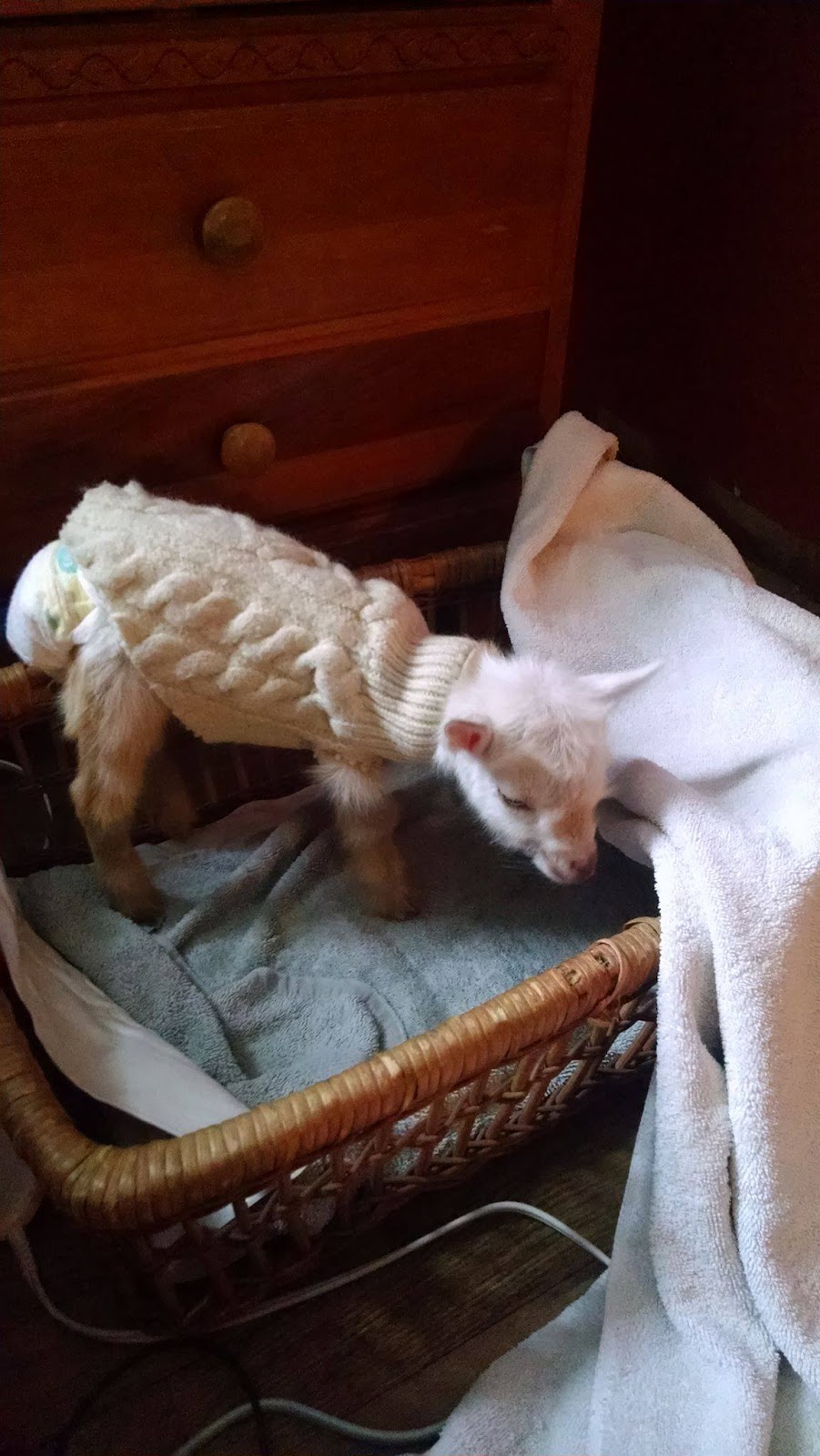

Here are some pictures of Cirrus when he was a baby. I have visited them, and I got to hold some baby goats and it was really great. When someone brought an animal to the priest to be offered to God, they were supposed to bring their best one. For sin offerings, they were to put their hands on the animal’s head, and make a confession before the animal was killed.

I tried to imagine doing that to little Cirrus here. Can you imagine? Maybe some of you do hunt or prepare animals for food, so it might be easier for you to be detached, but seriously, look at this cutie! Now imagine that you raised him from birth and he is the strongest, best looking animal that you have. You have walked with him to the altar and there he is bound by the priest and you put your hand on his head and speak your confession. The priest then slits his throat so that he dies quickly and so that the blood pours out on the altar. Then the priest would prepare the fat and organs to be consumed by the fire and prepare the meat to be eaten by himself and his family.

It is no accident that John the Baptist calls Jesus the Lamb of God. This would have been a vivid picture for the Jewish hearers. What about us today? What do we think of when we hear these words?

Jesus is the perfect sacrifice. God’s word says in Hebrews 10, “For by one sacrifice he has made perfect forever those who are being made holy. The Holy Spirit also testifies to us about this. First he says: “This is the covenant I will make with them after that time, says the Lord.
I will put my laws in their hearts, and I will write them on their minds.”Then he adds: “Their sins and lawless acts I will remember no more.” And where these have been forgiven, sacrifice for sin is no longer necessary.”
I invite you this morning to think of Jesus, the Lamb of God, who takes away the sins of the world.

He is nailed to a cross.

Imagine putting your hand on His head and speaking your confession. Speak it out loud. Name the things that are keeping you far from God.

He is lifted up.

Look at Him on the cross. He is there to show His love. His provision.

This is His body, broken for you. Take and eat.

This is His blood, shed for you. Take and drink.

Let us pray.